

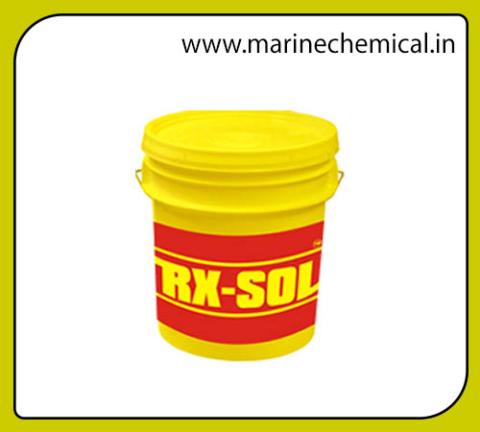
Product code RXSOL-50-5006-025
- Generic name
- Phosphate Control
- Pack size
- Hardness Phosphate Control protects against Deposition and corrosion of boiler systems reduces efficiency, and increases fuel and water consumption, and usage of RXSOL Hardness Phosphate Control regularly enhances boiler efficiency. This product is available in 25, 50, and 210 kg
- Unit
- Kg.PWD
- Quantity per unit
- 25.00
Hardness Control is a white dry powder Phosphate Boiler Water Treatment product used for the reduction of hardness in boilers. Hardness Control is highly soluble in water and It will precipitate calcium hardness as a non-adherent sludge.
Application
Hardness Control is formulated to form a precipitate with calcium ions which will not adhere to metal surfaces but are in a form suitable for blowdown.
Used for boilers and water softening.
Formation of Calcium Sulfate is main cause for SCALE formation :::
The principal problem potential posed by sulfate ions in water is the possibility of calcium sulfate scale formation. Precipitation of calcium sulfate can occur when high concentrations of both calcium and sulfate exist simultaneously. There are three primary areas of water treatment in which calcium sulfate precipitation may occur boilers, cooling systems, and ion exchangers operating in the hydrogen or acid mode.
In boilers, calcium sulfate scale formation has been reduced to a minimum by modern treatment practices. The low hardness levels largely preclude calcium sulfate boiler scale. By contrast, cooling systems are subject to calcium sulfate scale deposition because the makeup is usually not treated for hardness removal. Cooling water is usually treated with sulfuric acid for pH control, and the makeup is cycled, i.e. concentrated. Calcium sulfate scale deposition can result unless the cycles of concentration are properly controlled in conjunction with the proper use of scale control chemicals. Cation ion exchangers regenerated with sulfuric acid also can pose a major calcium sulfate problem. Calcium sulfate precipitation can be avoided by controlling the acid concentration and the flow rate through the exchanger.
Sulfate content can be calculated in Laboratory by using this method ::: http://rxmarine.com/SULFATE-TEST-KIT
Technical Specifications
Sampling And Testing
A sample of boiler water should be drawn for analysis daily. The sample should always be taken from the same point after blow down, cooled and tested immediately. Follow the Rxsol Hardness Test Kit instructions and fill the Boiler Water Log Form according to result results. It is important that regular testing is carried out to ensure levels of treatment are correct.
Physical Properties :
Appearance :White powder
Corrosive action :None
pH 1% solution :8.8
Flash point :None
Other Names
Green HC, Phosphate Control Boiler Water Treatment Chemicals, HCT 103 Norchem, Ferrolix L40, Ferrolix L40A, DM-527, Fostreat, ADJUNCT Hardness Phosphate Control 25 Kgs Powder Pack
Useful Area
Industrial Area
#BoilerWaterTreatment_HardnessCONTROL
#BoilerWaterTreatmentCHEMICAL_SUPPLIER
#BoilerWaterTreatment_supplierUAEdubai
#BoilerWaterTreatment_supplierOMANmuscat
A precipitant designed to eliminate scale deposits and lower the hardness of water in boilers with working pressure up to 60 bars.
It is used in conjunction with alkaline liquid to prevent calcium scale deposits. Both products are used in our standard boiler water treatment programs for low-pressure boiler systems (0-32 bar) and medium-pressure steam propulsion vessels (32-60 bar).
Phosphate/pH relationship recommended to control boiler corrosion. Different forms of phosphate consume or add caustic as the phosphate shifts to the proper form. For example, addition of monosodium phosphate consumes caustic as it reacts with caustic to form disodium phosphate in the boiler water according to the following reaction:
| NaH2PO4 | + | NaOH | ® | Na2HPO4 | + | H2O |
| monosodium phosphate | sodium hydroxide | disodium phosphate | water |
Conversely, addition of trisodium phosphate adds caustic, increasing boiler water pH:
| Na3PO4 | + | H2O | ® | Na2HPO4 | + | NaOH |
| trisodium phosphate | water | disodium phosphate |
sodium hydroxide |
Precautions & Remarks
Phosphate/pH relationship recommended to control boiler corrosion. Different forms of phosphate consume or add caustic as the phosphate shifts to the proper form. For example, addition of monosodium phosphate consumes caustic as it reacts with caustic to form disodium phosphate in the boiler water according to the following reaction:
| NaH2PO4 | + | NaOH | ® | Na2HPO4 | + | H2O |
| monosodium phosphate | sodium hydroxide | disodium phosphate | water |
Conversely, addition of trisodium phosphate adds caustic, increasing boiler water pH:
| Na3PO4 | + | H2O | ® | Na2HPO4 | + | NaOH |
| trisodium phosphate | water | disodium phosphate |
sodium hydroxide |
Identification
How to extend boiler life?
Hardness Phosphate Control Boiler Treat is a chemical formulation developed for steam boiler water treatment.
Hardness Phosphate Control Boiler Treat is formulated as a corrective phosphate for boiler water treatment following primary decarbonization through ion exchange, as well as for the treatment of non-decarbonized feed water in steam boilers. It is intended for use with soft to medium-hard water, provided that the total hardness does not exceed 2.7 mol/m³ (270 ppm as CaCO₃).
Due to its stabilizing properties, Hardness Phosphate Control Boiler Treat protects feed lines against scale formation. The sludge formed inside the boiler undergoes flocculation, resulting in a loose, flaky structure that can be easily discharged through blowdown. In addition, the boiler surfaces are safeguarded against corrosion, and continuous application helps reduce existing scale deposits.
Oxygen-binding components react with residual dissolved oxygen present in feed water and boiler water, thereby minimizing corrosion risks. The formulation also contains antifoaming agents that prevent foam formation in highly alkaline conditions or when boiler water salt concentrations are elevated.
Hardness Phosphate Control Boiler Treat is non-volatile.
The product should be applied after primary decarbonization by ion exchange and is suitable for all types of steam boilers, excluding disposable heating boilers. A 1–2% solution is dosed to maintain 10–15 ppm P₂O₅ in boiler water. Typically, a dosage of 5–6 g/m³ of product is sufficient for feed water. If insufficient thermal deaeration results in oxygen levels exceeding 2 mg/l, it is recommended to use a dedicated RXSOL OxyControl containing a higher concentration of oxygen-binding agents.
For feed water treatment, the solution is continuously dosed at 1–2% to maintain 10–15 ppm P₂O₅ in boiler water. Generally, when total hardness is approximately 20 ppm (as CaCO₃), a dosage of 10–15 g of product per cubic meter of feed water is required. The precise dosage depends on both total and carbonate hardness and should be determined with support from technical specialists. If the feed water is slightly alkaline, an alkaline-adjusted variant of Hardness Phosphate Control Boiler Treat should be used.
Keywords
Deposition and corrosion of boiler systems reduce efficiency, increase fuel and water consumption, and may lead to failures, which are a safety hazard, add maintenance costs and may impede production. RXSOL's boiler water internal treatment programs provide highly effective protection against corrosion and scale formation to ensure optimum performance and availability of your steam system while reducing the total cost of ownership and environmental footprint through energy and water savings.
Better BOILER TREATMENT practices
It is used in conjunction with RXSOL pH Booster concentrated liquid to prevent calcium scale deposits. Both products are used in standard boiler water treatment programs for low pressure boiler systems (0-32 bar) and medium-pressure steam propulsion vessels (32-60 bar). They are also used for high pressure steam generating systems (60-84 bar). The use of Hardness Phosphate Control treatment in conjunction with RXSOL pH Booster concentrated alkaline liquid converts calcium hardness into soft, non-adherent sludge that is easily removed by blowdown.
Supply Locations
Hardness Phosphate Control is available in several packaging sizes at several stock points like Fujairah, Dubai, Muscat, Barka, Nairobi Kenya, Uganda, Africa Canada, Bristish Columbia, Mumbai, Thane, Kandla, Gandhidham, Vizag, Vishakhapatnam, Ennore, Chennai, Kolkata.